
7 Features Every Modern Home Builder Website Needs
SEO Title: 7 Features Every Modern Home Builder Website Needs in 2026 Meta Description: Discover the 7 must-have features for a modern home builder website — from interactive commu
It's 9:47 PM on a Tuesday. A couple is sitting on their couch scrolling through builder websites, narrowing down where they want to build their next home. They land on your site, tap into a community page, and find a PDF site plan from 2023 with a "Call for Availability" banner across the top.
They don't call. They bounce. And they find a competitor whose site lets them explore available lots, filter floor plans, and request info — all before the sales office opens in the morning.
This is the gap between a builder website that works and one that just exists. Here are the seven features that separate the two.
1. Real-Time Lot Availability
Nothing kills buyer confidence faster than outdated inventory. When a buyer clicks into a community and can't tell which lots are available, which are sold, and which are under contract, they assume the worst — or they just leave.
A modern builder website should display lot status in real time: available, sold, pending, or reserved. Pricing transparency is a bonus. The goal is to eliminate the "call us to find out" friction that sends motivated buyers elsewhere.
Builders using platforms like ForgeHome can sync their inventory directly to their website, so lot status updates automatically as sales happen. No more manually editing PDFs or asking your marketing team to update the site every time a contract comes in.
The result? Fewer repetitive "is this lot still available?" calls for your sales team and more qualified inquiries from buyers who already know what's open.
2. Interactive Community Maps
Static site plan images are one of the most common missed opportunities on builder websites.
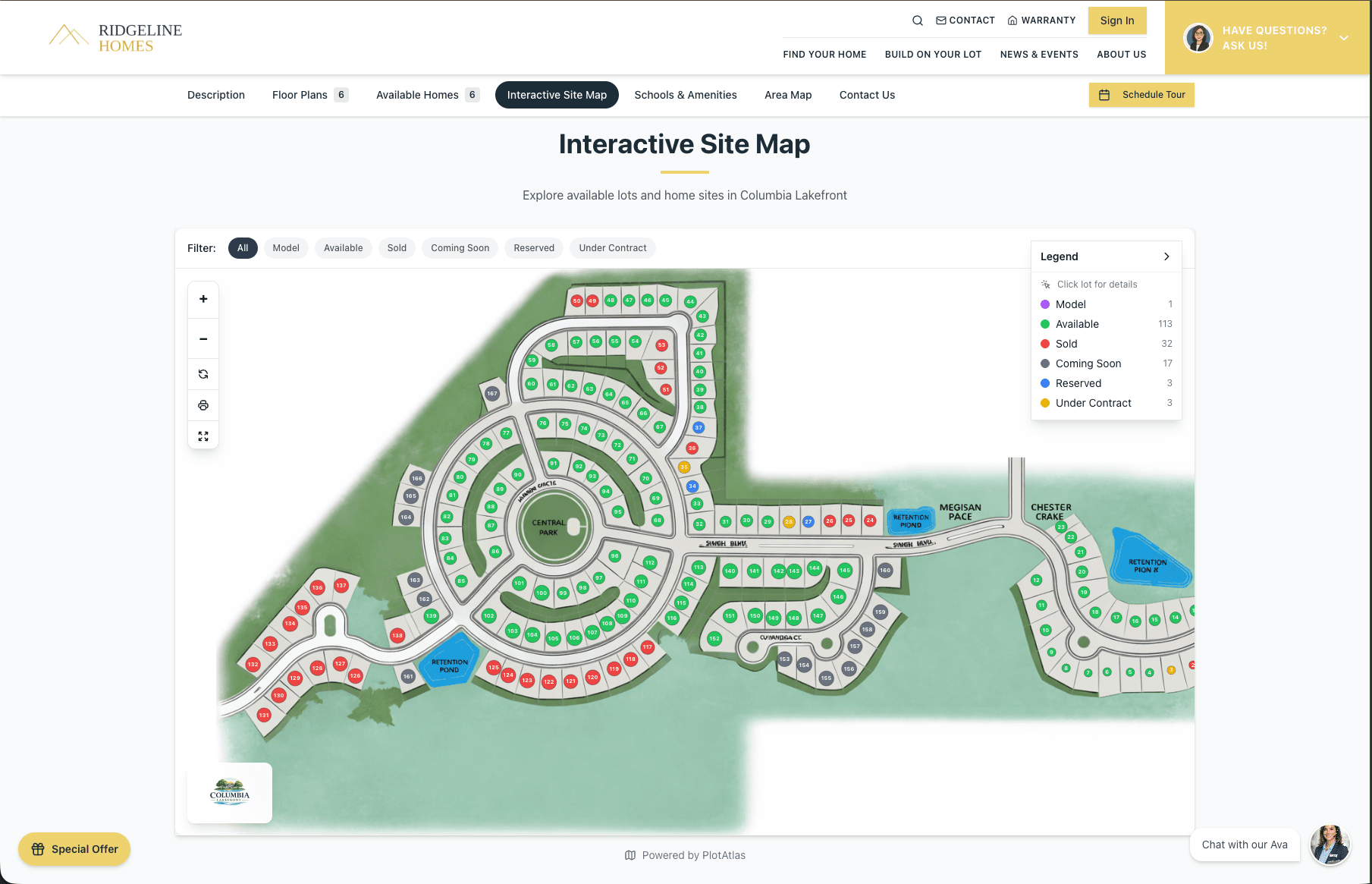
An interactive community map transforms a flat image into a tool buyers actually use. Hover over a lot to see its status. Click to view pricing, dimensions, and compatible floor plans. Filter by availability or lot type. Zoom in on amenities, green spaces, and nearby features.
This isn't a nice-to-have anymore — it's what buyers expect. They're used to interactive experiences from platforms like Zillow and Realtor.com, and they expect the same from your website.
Tools like PlotAtlas let builders convert their existing plat maps into fully interactive, embeddable experiences — without rebuilding their entire site. The maps integrate directly into any website and keep lot data in sync, so your community pages always reflect current availability.
Interactive maps consistently increase time on site, engagement, and lead quality because buyers self-qualify before they ever pick up the phone.
3. Floor Plan Filtering and Comparison
Today's buyers shop with filters. They know they want 4 bedrooms, at least 2,500 square feet, and a first-floor primary suite. If your website can't surface that in seconds, you're losing them to builders whose sites can.
Your floor plan pages should support filtering by bedroom and bathroom count, square footage range, price range, and features. Ideally, buyers should be able to compare two or three plans side by side — the same way they'd compare products on any other purchase.
If your floor plans live inside downloadable PDFs with no search functionality, you're asking buyers to do work that your website should handle for them.
ForgeHome includes built-in floor plan libraries with filtering, comparison tools, and direct links between plans and the communities where they're available. Every plan page becomes a lead capture opportunity tied to specific buyer intent.
4. Mobile-First Performance
More than half of home searches start on a phone. And "responsive" isn't enough anymore — your site needs to be designed for mobile first, not adapted to it as an afterthought.
That means fast load times (under 3 seconds), thumb-friendly navigation, forms that are easy to complete on a small screen, and images that don't take forever to render. If a buyer has to pinch and zoom to read your floor plan specs, you've already lost them.
Mobile performance also has a direct impact on SEO. Google uses mobile-first indexing, which means it evaluates the mobile version of your site before the desktop version when determining rankings. A sluggish mobile experience doesn't just frustrate buyers — it buries you in search results.
ForgeHome sites are built mobile-first from the ground up, with optimized image delivery, streamlined navigation, and lead forms designed for one-handed use.
5. Context-Aware Lead Capture
A generic "Contact Us" form at the bottom of your homepage is doing the bare minimum. It works, but it gives your sales team almost nothing to work with.
Context-aware lead capture means tying your forms to specific intent. Instead of "Contact Us," the CTA on a lot detail page says "Request Info About Lot 14." On a floor plan page, it says "Schedule a Tour of The Ashton." On a community page, it says "Get Pricing for Riverstone."
This does two things. First, it increases conversion rates because the ask feels specific and relevant rather than generic. Second, it gives your sales team meaningful context for follow-up. They know exactly what the buyer was looking at, which community they're interested in, and what stage of the funnel they're in.
ForgeHome bakes this into every page type automatically. Every lot, plan, and community has contextual CTAs that feed directly into your CRM with full attribution data — so your team knows not just who reached out, but what caught their attention.
6. SEO-Optimized Community Pages
Most builder websites treat community pages as an afterthought — a hero image, a paragraph of marketing copy, and a link to download the site plan. That's a massive missed opportunity.
Every community page should be a standalone SEO asset. That means including city and neighborhood keywords naturally in the content, featuring nearby schools, shopping, and amenities, displaying current available inventory, and linking internally to related floor plans and quick move-in homes.
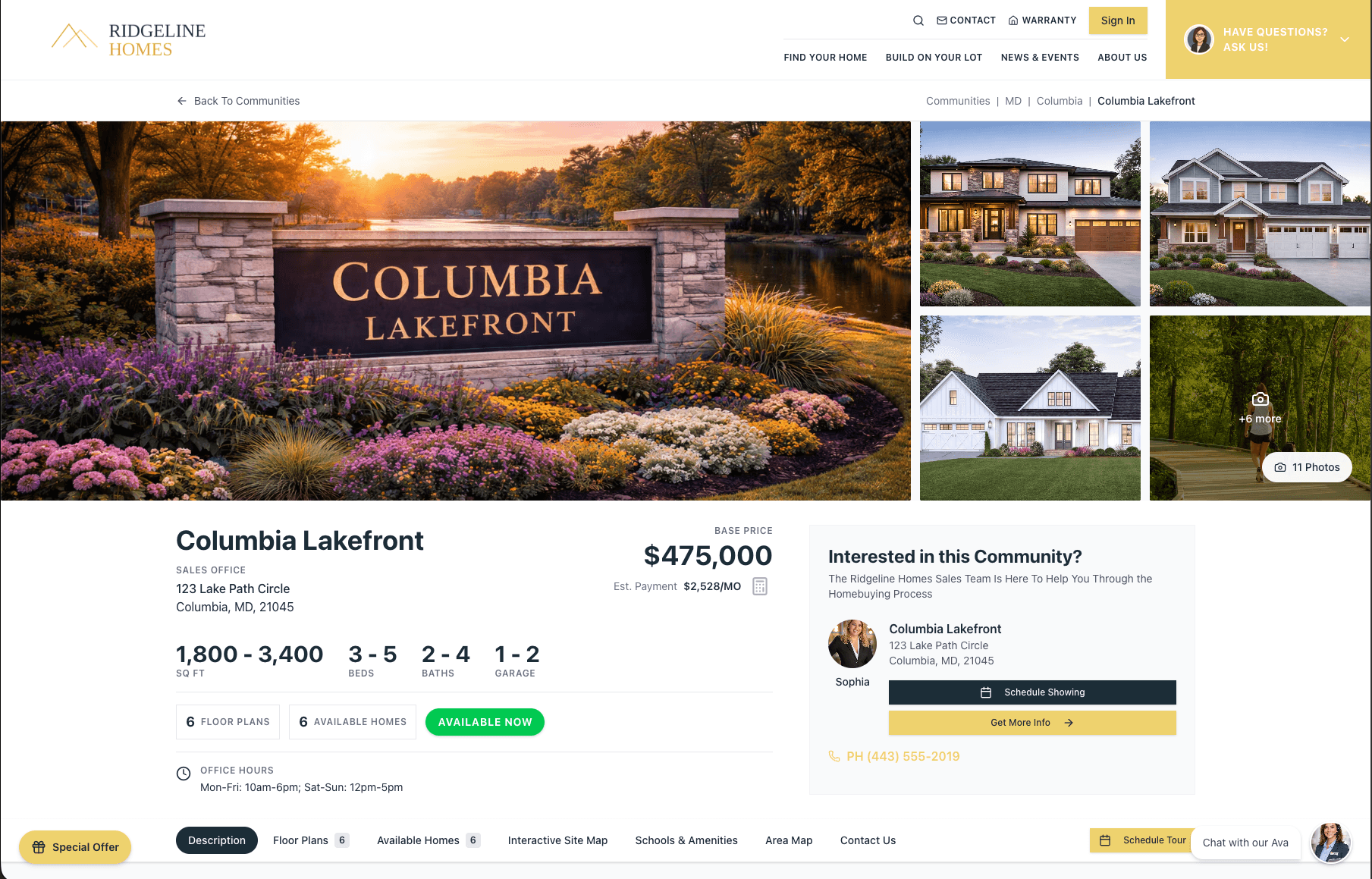
When structured properly, each community page can rank independently for searches like "new homes in [City]," "new construction near [School District]," or "move-in ready homes in [Neighborhood]."
ForgeHome generates SEO-optimized community pages with structured data, internal linking, and dynamic inventory sections built in. Instead of one homepage competing for traffic, you have a network of community pages each pulling in organic visitors from different local searches.
7. Buyer Behavior Analytics
You wouldn't run a sales office without tracking foot traffic, sign-ins, and which models buyers visit. Your website should give you the same visibility.
A modern builder website should track which communities get the most views, which lots get the most clicks, how buyers use filters and what they search for, where buyers drop off in the funnel, and which CTAs convert at the highest rate.
This data directly informs pricing decisions, marketing spend allocation, inventory prioritization, and website optimization. Without it, you're guessing.
ForgeHome includes built-in analytics dashboards that surface these insights without requiring your team to dig through Google Analytics. You can see at a glance which communities are generating heat, which floor plans are trending, and where your funnel needs attention.
PlotAtlas provides its own layer of map-specific analytics — showing which lots buyers interact with most, how long they spend exploring the map, and which lot clicks convert to inquiries. It's data you can't get from a static site plan.
Your Website Is Your Best Sales Tool
The gap between a builder website that generates leads and one that just looks nice isn't about aesthetics. It's about functionality.
A site with real-time inventory, interactive maps, smart filtering, mobile performance, contextual lead capture, strong SEO, and meaningful analytics doesn't just support your sales team — it does a significant portion of the qualifying work before a buyer ever makes contact.
If your current site is missing more than a couple of these features, the cost isn't just a worse website. It's lost leads, wasted sales time, and market share going to competitors who've already made the investment.
Ready to see what a purpose-built builder website looks like? Explore ForgeHome for your full website platform, or start with PlotAtlas to add interactive community maps to your existing site.
ForgeHome and PlotAtlas are products of ForgeDBI, built specifically for how home builders sell homes.
