
Interactive Site Plans vs. Static PDFs: What Actually Converts for Home Builders
Most home builders still rely on static site plan PDFs to show lot availability. It's what they've always done — scan the site plan, mark it up, upload it to the website or email i
Most home builders still rely on static site plan PDFs to show lot availability. It's what they've always done — scan the site plan, mark it up, upload it to the website or email it to prospects.
But here's the problem: buyers don't experience those PDFs the way builders intend.
What Buyers Actually See When You Send a PDF Site Plan
A buyer lands on your community page, finds a link to the site plan, and downloads a PDF. Now they're looking at a flat image with lot numbers, maybe some color coding, and no way to interact with it.
They can't click a lot to see pricing. They can't filter by availability. They can't tell which lots are still available versus which ones sold last week. They're interpreting a document that was designed for internal planning, not for selling homes.
If the PDF is outdated — and it usually is — they're making decisions based on wrong information. If it's accurate but confusing, they call your sales team to ask basic questions that should have been answered on the page.
Either way, you've added friction to the buying process at the exact moment the buyer was ready to engage.
The Real Cost of Static Site Plans
The issue isn't just the PDF itself. It's what happens because of it.
Buyers who can't quickly understand what's available tend to leave the page. They don't call. They don't fill out a form. They just move on to the next community that makes it easier.
Your sales team spends time answering questions about lot availability, pricing, and status — information that should be self-service on your website. Every phone call about "is lot 14 still available?" is time not spent closing.
And generic contact forms capture inquiries with no lot context. Your team gets a name and an email, but no idea which home or lot the buyer was interested in. That makes follow-up harder and less effective.
What an Interactive Site Plan Actually Does
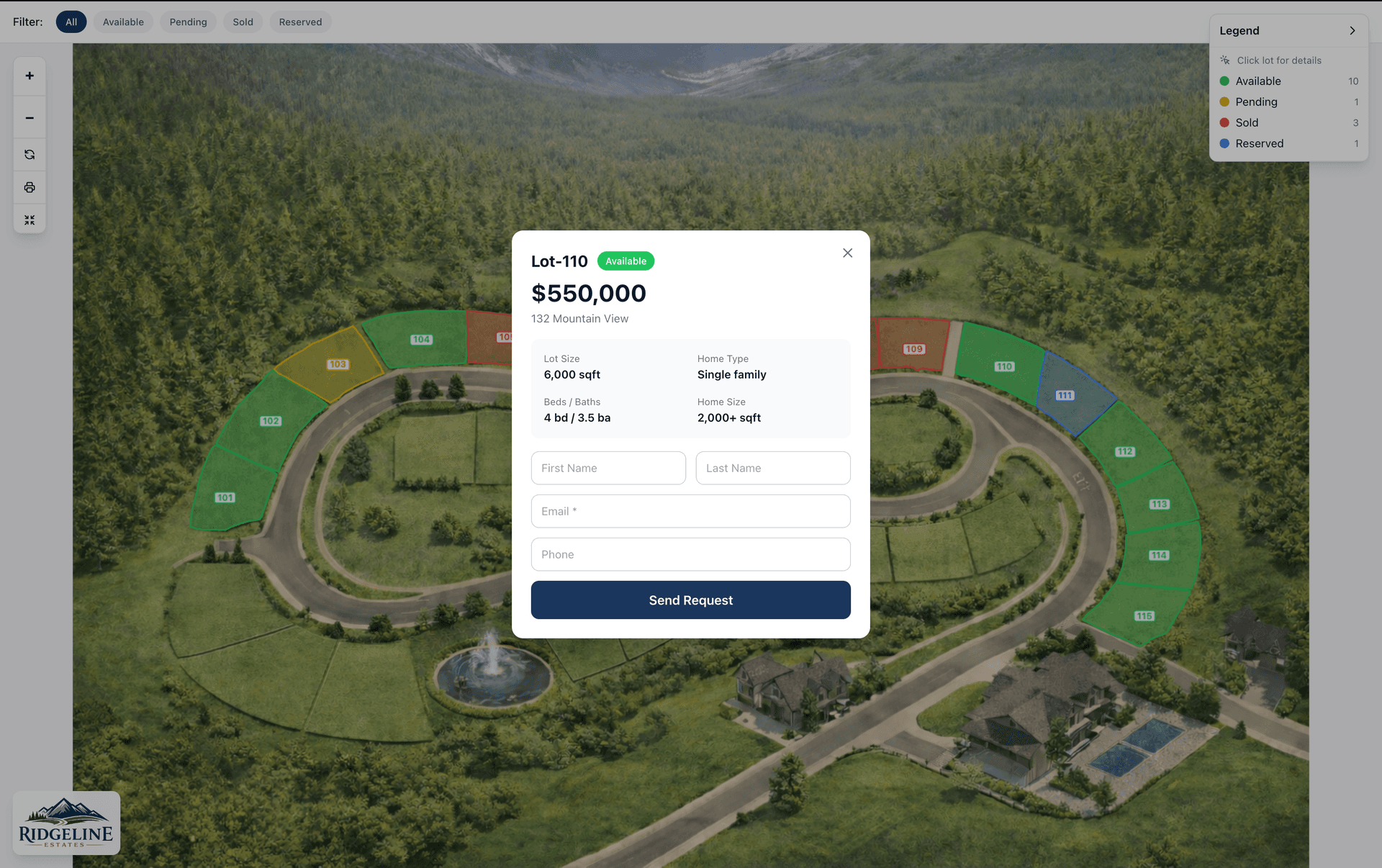
An interactive site plan replaces the static PDF with a clickable, visual map directly on your community page. Each lot is a clickable element that shows its current status — available, sold, under contract, or coming soon.
When a buyer clicks an available lot, they see the price, the lot size, which floorplans are compatible, and a form to request information about that specific lot. No downloading. No guessing. No calling to ask basic questions.
The information is always current because it updates in real time. When a lot sells, it changes status on the map immediately. Your sales team doesn't need to re-upload a PDF every time something changes.
From the buyer's perspective, the experience goes from "download this PDF and figure it out" to "click any lot and see everything you need to know." That's a significant reduction in friction.
The Impact on Lead Quality
The biggest difference isn't just engagement — it's the quality of inquiries your team receives.
With a static PDF and a generic contact form, you get leads that say "I'm interested in your community." Your sales team has to call back, qualify the buyer, and figure out what they're actually looking for.
With an interactive map and lot-specific forms, you get leads that say "I'm interested in Lot 14 — The Aspen floorplan at $724,900." Your team knows exactly what the buyer wants before they pick up the phone. That changes the entire follow-up conversation.
Higher-intent leads tied to specific lots and homes mean faster follow-up, better conversion rates, and less time wasted on unqualified inquiries.
What This Looks Like in Practice
Here's a live example of an interactive community page with lot-level availability, floorplan comparison, and lot-specific lead capture: demo.forgedbi.com
Buyers can see exactly what's available, compare floorplans side by side, and request information about specific homes — all without leaving the page.
This is the kind of experience that modern buyers expect. They comparison-shop everything online. They expect the same clarity from a home builder that they get from any other major purchase.
You Don't Need a Full Website Redesign
The most common objection to upgrading from static PDFs to interactive maps is scope. Builders assume it requires a full website rebuild, a new CMS, or a months-long development project.
It doesn't.
An interactive community page can be built as a standalone upgrade that works alongside your existing website. Your team links to it from your current site, marketing emails, or sales materials. No platform migration. No redesign.
This means you can see the impact on a single community before deciding whether to expand further. Here's how the Community Upgrade Program works.
Making the Switch
If your community pages still rely on static site plans, you're creating unnecessary friction for buyers who are ready to engage. The information they need is locked inside a document format that wasn't designed for them.
Interactive site plans solve this by making availability, pricing, and lot details immediately accessible — and by capturing higher-quality leads tied to specific buyer interest.
You can see what this looks like for your community with a free 10-minute review.
