
What Homebuyers Actually Want From a Builder's Website in 2026
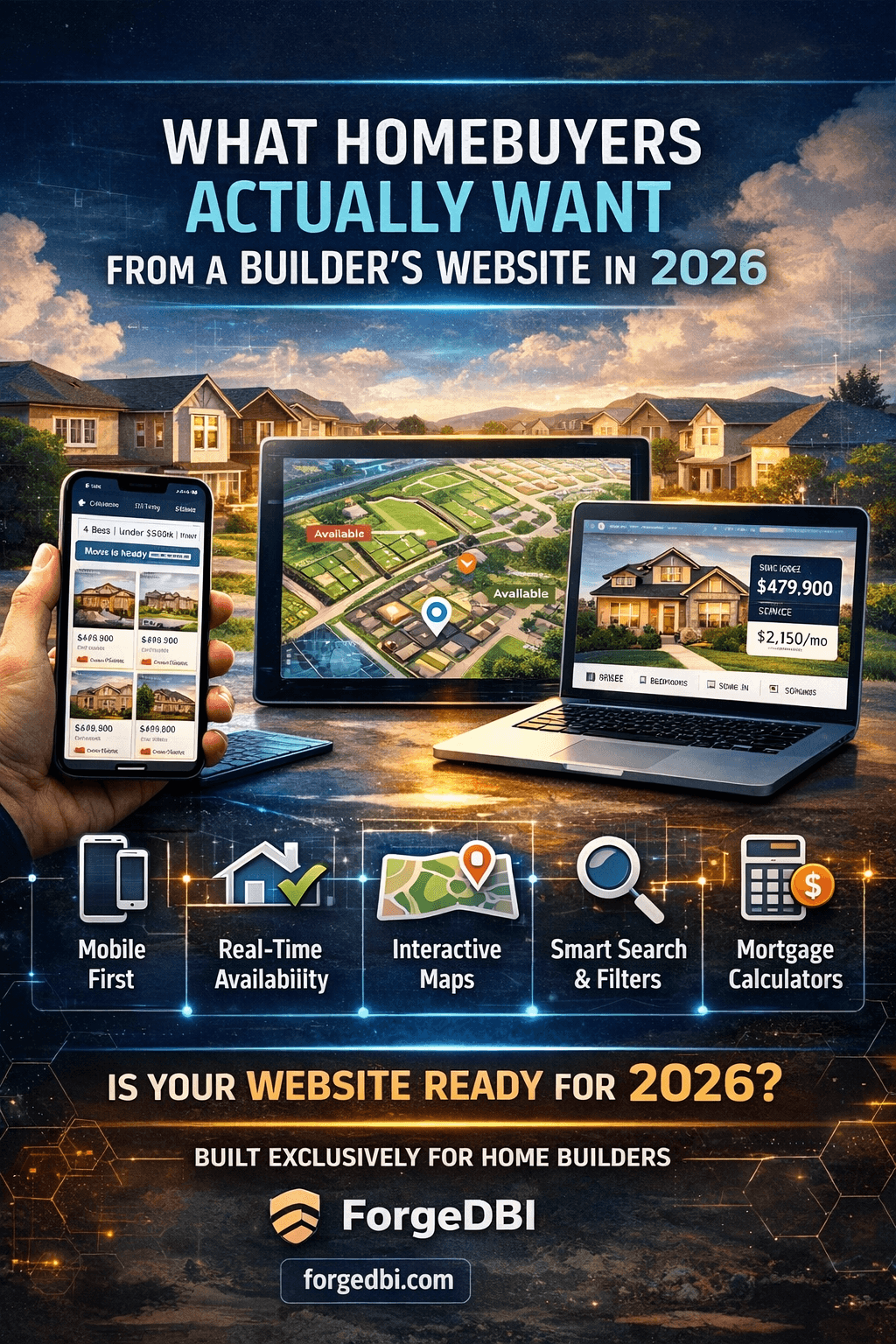
Most home builder websites were designed to impress other builders — not the buyers actually shopping for homes. They have a nice hero photo, a few pages about the company, maybe a
Most home builder websites were designed to impress other builders. Not buyers.
They have a nice photo on the homepage, a few pages about the company, maybe a contact form buried somewhere. And that's about it. No real-time availability. No way to filter homes by price or move-in date. No interactive maps. Just a digital brochure that hasn't been updated since the last redesign — which was probably four years ago.
Meanwhile, buyers have moved on entirely.
The data is clear: the way people shop for homes in 2026 has almost nothing in common with how builder websites are built. And the gap is costing builders leads they'll never know they lost.
Here's what buyers actually expect — and what most builder sites are still getting wrong.
The Search Starts Online. Every Time.
According to the National Association of REALTORS' 2025 Profile of Home Buyers and Sellers, more than half of all buyers found the home they purchased through online search. Nearly half started their home search online before ever contacting an agent or visiting a community.
That's not surprising. What's surprising is how many builders still treat their website as an afterthought — something they check off during a rebrand and then forget about.
Here's the reality: your website is your first showing. Before a buyer drives to your model home, before they talk to your sales team, before they request a brochure — they Google you. And what they find (or don't find) determines whether they ever take the next step.
If your site loads slowly, doesn't work on their phone, or can't answer the basic questions they have — how much does it cost, what's available, and when can I move in — they leave. They don't call your office to ask. They just leave. And they find a builder whose site gave them what they needed in 30 seconds.
Mobile Isn't a Feature. It's the Starting Point.
NAR's data shows that 70% of buyers used a mobile device or tablet during their home search. Not as a backup to their laptop — as their primary research tool. They're scrolling listings on the couch after dinner. They're pulling up floorplans at their kid's soccer game. They're comparing communities from the parking lot of the grocery store.
And yet, a significant number of builder websites still aren't mobile-responsive. Or worse, they technically are — the layout adjusts to the screen size — but the experience is terrible. Tiny text, pinch-to-zoom floorplan images, PDF downloads that open in a new tab and take 30 seconds to load. On mobile, that's not a minor inconvenience. That's a dead end.
A builder website in 2026 needs to be designed for mobile first — not adapted for it after the fact. That means thumb-friendly navigation, fast-loading images, floorplans that render natively in the browser (not as PDFs), and forms that take 10 seconds to fill out, not 60.
If a buyer can order dinner, book a flight, and check their investment portfolio from their phone in under a minute, your website needs to keep up.
Buyers Want to Search, Not Browse
There's a fundamental difference between browsing and searching — and most builder sites only support browsing.
Browsing is clicking through community pages one at a time, trying to piece together which ones have homes in your price range, with the number of bedrooms you need, available when you need them. It's slow. It's frustrating. And it assumes the buyer has unlimited patience and nothing better to do.
Searching is what buyers actually want: tell me what you're looking for — 4 bedrooms, under $500K, move-in ready by summer — and here's what we have that matches.
This is standard functionality on every major e-commerce site and every real estate portal. Zillow has it. Amazon has it. Your builder website probably doesn't.
Buyers in 2026 expect to filter homes by price, bedrooms, bathrooms, square footage, community, and move-in date — at minimum. They expect to sort results. They expect to compare floorplans side by side. And they expect the results to be accurate and current, not a month out of date because someone forgot to update a PDF.
If your website can't do this, you're forcing buyers to work harder to give you money. That's a problem only your competitors benefit from.
Real-Time Availability Is the New Table Stakes
Nothing kills trust faster than outdated information. A buyer finds a home on your website, gets excited about the price and the floorplan, drives 30 minutes to the community — and finds out it sold two weeks ago.
That doesn't just lose one sale. It loses a buyer's confidence in everything else on your site. If that listing was wrong, what else is wrong? Are the prices current? Are those floorplans still available? Is this community even active?
In 2026, buyers expect real-time lot availability and pricing. Not "call for pricing." Not "contact us for availability." Actual, current, published data — the same way they'd see inventory on any other retail website.
This means your website needs to be connected to the same data your sales team uses. When a lot status changes, the site updates. When a price adjusts, the listing reflects it. When a home sells, it comes down. Automatically. Not after someone emails the web team and they get to it next Tuesday.
Builders who show real-time availability build trust before the first conversation even happens. Builders who hide it — intentionally or through neglect — create friction that sends buyers to the builder down the road who didn't.
Interactive Maps Are Expected, Not Optional
NAR's research shows that neighborhood quality and proximity to friends and family now outrank convenience to work as the top factors buyers consider when choosing a location. That trend has been building for years, accelerating through the remote work era and holding steady even as return-to-office mandates have increased.
What does that mean for builder websites? It means buyers don't just want to see a photo of your community entrance. They want to understand the community — spatially. Where are the homes? Which lots are available? What's the layout of the streets? Where are the amenities? What's the lot size? What direction does the backyard face?
Static site plan images — the ones you print on a trifold and hand out at the model — don't answer these questions online. They're flat, they're often low resolution, and they can't show which lots are available, under contract, or sold.
Interactive community maps let buyers explore your community the way they'd explore a neighborhood on Google Maps. Click a lot, see what's available. Filter by status, price, or floorplan. See the home's position relative to the clubhouse, the park, or the school. This is the kind of experience buyers have on Zillow and Redfin — and they expect it from the builder's own site.
When Google started testing embedded home listings directly in search results in late 2025 — showing property photos, prices, and tour request buttons right on the results page — it signaled something builders should take seriously: the bar for how buyers discover and evaluate homes online is being set by the largest technology companies in the world. Your site is being compared to that experience, whether you intended it or not.
Lead Capture Should Be Built In, Not Bolted On
Most builder websites treat lead capture as an afterthought. There's a "Contact Us" page somewhere in the navigation, maybe a generic form asking for name, email, phone number, and "tell us what you're interested in." It's the equivalent of handing someone a blank index card and hoping they write something useful on it.
Buyers in 2026 expect contextual lead capture — forms that know what the buyer was looking at when they decided to reach out. If they were viewing the Ridgeline floorplan at Fulshear Crossing, the inquiry should pre-fill that information. If they clicked "Schedule a Tour," the system should know which community they want to tour.
Beyond forms, the best builder websites capture intent signals throughout the entire browsing experience. A buyer who viewed three floorplans, compared two communities, and checked mortgage rates is a very different lead than someone who landed on the homepage and bounced after four seconds. Your sales team should know the difference.
And that lead needs to go somewhere useful — not a shared inbox that three people sort of check. CRM integration isn't a nice-to-have. It's the connective tissue between your website and your sales process. Lasso, HubSpot, Salesforce — whatever your team uses, the website should feed leads directly into it with full context attached.
Mortgage Tools Move Buyers From Browsing to Buying
With mortgage rates averaging 6.69% through 2025 and median down payments hitting levels not seen in decades, affordability is the single biggest factor on every buyer's mind. NAR's data shows that the median down payment for first-time buyers reached 10% — the highest since 1989 — while repeat buyers hit 23%.
Buyers aren't just looking at listing prices anymore. They're calculating monthly payments, factoring in down payment scenarios, and comparing what they can afford across different communities and floorplans.
A builder website that includes a mortgage calculator — not a generic one, but one tied to specific home prices — gives buyers the confidence to move forward. Show them the estimated monthly payment on the actual home they're looking at, with adjustable inputs for down payment percentage and interest rate. Let them see what the difference is between the 3-bedroom at $374,900 and the 4-bedroom at $459,900 in real monthly dollars.
This isn't about replacing a lender. It's about removing the mental math that slows decisions down. When a buyer can see that their dream home costs $127 more per month than the one they were settling for, they upgrade. When they can't see that, they default to the cheaper option or keep looking elsewhere.
Speed and Performance Are Invisible Until They're Not
Nobody notices a fast website. Everyone notices a slow one.
Google has published extensive research showing that as page load time increases from 1 second to 3 seconds, the probability of a visitor leaving increases by 32%. From 1 to 5 seconds, it jumps to 90%. On mobile networks — where most of your buyers are — this is the difference between capturing a lead and losing one.
Builder websites are often slow for predictable reasons: uncompressed hero images, too many third-party scripts, heavy sliders that load 15 photos on the homepage when the buyer will only see three. These are solvable problems, but they require a platform that's been optimized for performance — not a WordPress site with 23 plugins that hasn't been updated in 18 months.
Page speed also directly affects your search rankings. Google has used site speed as a ranking factor for over a decade, and with the introduction of Core Web Vitals, it now measures loading performance, interactivity, and visual stability as explicit ranking signals. A slow builder website doesn't just frustrate buyers — it makes you harder to find in the first place.
What This All Adds Up To
Here's the uncomfortable truth: most builder websites were built by agencies that build websites for everyone — law firms, restaurants, dentists, home builders. The same team, the same CMS, the same approach. They look fine. They photograph well for the portfolio page. But they don't do what a builder's website actually needs to do.
A builder's website isn't a brochure. It's a sales tool. It needs to show real-time inventory, let buyers search and filter, render floorplans on mobile, capture leads with context, integrate with your CRM, and load fast enough that buyers don't leave before they see a single listing.
That's not a WordPress site with a page builder and a prayer. That's a platform — purpose-built for how home builders sell and how buyers actually shop.
At ForgeDBI, we build exclusively for home builders. Our platform, ForgeHome, was designed from the ground up around communities, floorplans, available homes, and lot inventory — not adapted from a template that was originally built for a law firm. Everything buyers expect in 2026 — real-time availability, mobile-first design, interactive maps, smart filtering, mortgage tools, and CRM integration — is built into the foundation.
If your current website isn't doing these things, it's not a design problem. It's a platform problem. And it's one worth solving before your next buyer finds the builder who already did.
ForgeDBI builds websites and technology exclusively for home builders. See what a builder-specific platform looks like at forgedbi.com, or explore the ForgeHome platform at forgedbi.com/forgehome.
